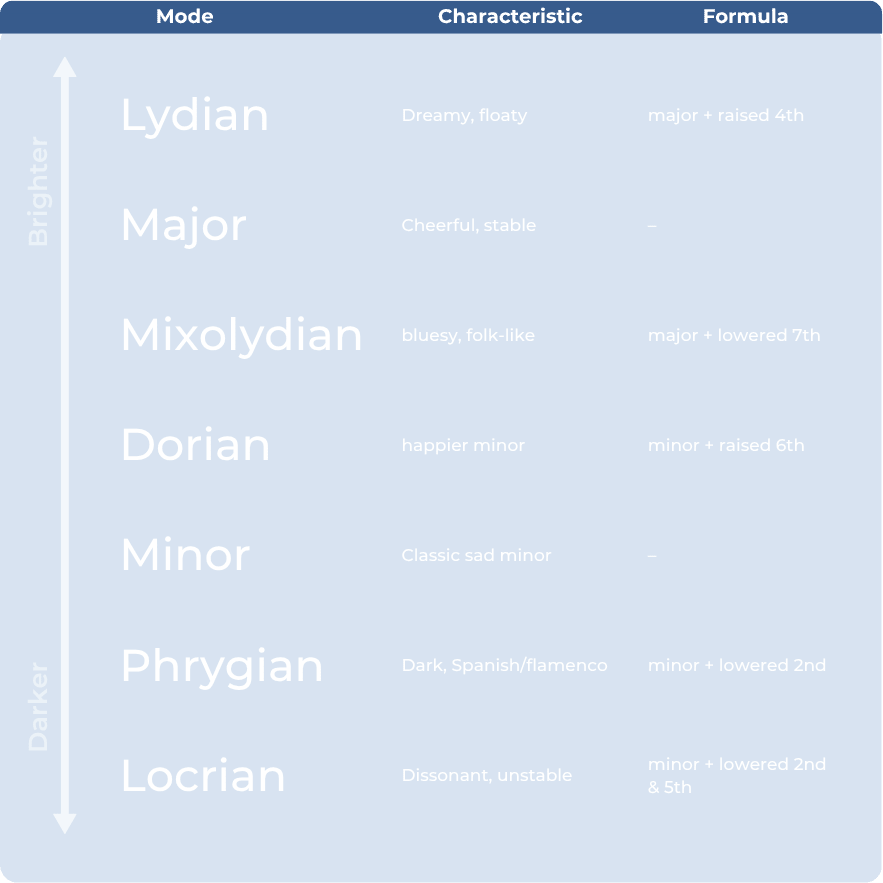
Mode
A mode is a way of organizing a scale by choosing a different note as the home base. All seven modes are built from the same set of notes as the major scale — they are simply rotations of it, each starting on a different scale degree. This change in starting point gives each mode its own distinct flavor and emotional character, even though the underlying notes remain the same.
For example, the C major scale (C, D, E, F, G, A, B) can be thought of as:
- Ionian (starting on C)
- Dorian (starting on D)
- Phrygian (starting on E)
- Lydian (starting on F)
- Mixolydian (starting on G)
- Aeolian or natural minor (starting on A)
- Locrian (starting on B)
Though all these modes contain the same notes, the emphasis on different home chords and cadences gives each one a unique harmonic and melodic identity. For example, Dorian often sounds smooth and soulful, while Phrygian has a darker, more dramatic feel.
Because modes reuse the same notes as the major scale, determining the correct mode for a song can sometimes be ambiguous. A progression might hint at several possible home chords, and the interpretation of mode may depend on melodic context or where the music feels most resolved. This ambiguity is a feature, not a flaw — it gives songwriters expressive flexibility and invites creative reinterpretation.
Modes are an important tool for understanding how different emotional qualities can emerge from the same set of notes — and for expanding the harmonic language of a song beyond the typical major or minor scale.