Chord Voicing
Chord voicing refers to the way the individual notes of a chord are arranged when it’s played. Even though two chords may have the same notes, they can sound very different depending on how those notes are spaced, ordered, and distributed across octaves.
Voicings can be closed/tight (with notes close together), open (spread across octaves), or anything in between. Notes can be repeated or omitted, and the chord may include added tones for color. As long as the chord’s bass note stays the same, the chord retains its identity — just with a different texture or feel (if the bass note is swapped for a different chord tone, the chord is said to be in an inversion).
Below, you can hear several different voicings of a I chord. Instead of displaying a chord block, these examples show the individual notes of each voicing in the melody staff. Although each version sounds a little different, they all function as the same I chord from a harmonic standpoint:

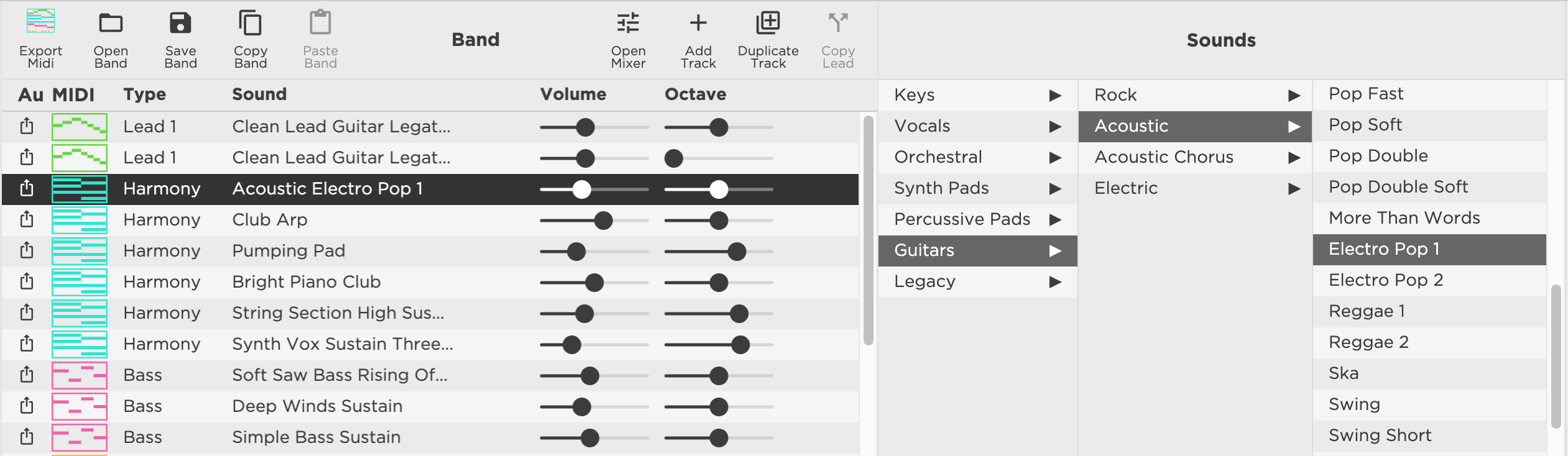
Hookpad gives you control over chord voicing through the Band panel. You can choose from different instrument styles (e.g., guitar, piano, strings), and each instrument offers voicing and rhythm options that affect how chords are played. For example, some piano styles will play chords tightly clustered around middle C, while others spread the notes wider for a fuller sound.
In addition, the Band panel includes an octave centering tool. This lets you shift the voicing of your chords higher or lower on the instrument, helping you shape the tone and energy of your arrangement.