Stepwise Bassline
Stepwise bass motion refers to chord progressions in which the bass moves by small intervals, often one scale degree at a time. These bass movements help connect chords smoothly and give a song a sense of forward motion and coherence. Although the melody and harmony may be complex, stepwise motion in the bass creates an underlying structure that listeners intuitively follow.
While many chord progressions use root position chords (where the root is the lowest note), using inversions allows composers to guide the bass along a more connected path. This technique is particularly effective for shaping the emotional flow of a song and is found in countless examples across popular music.
Ascending and Descending Basslines
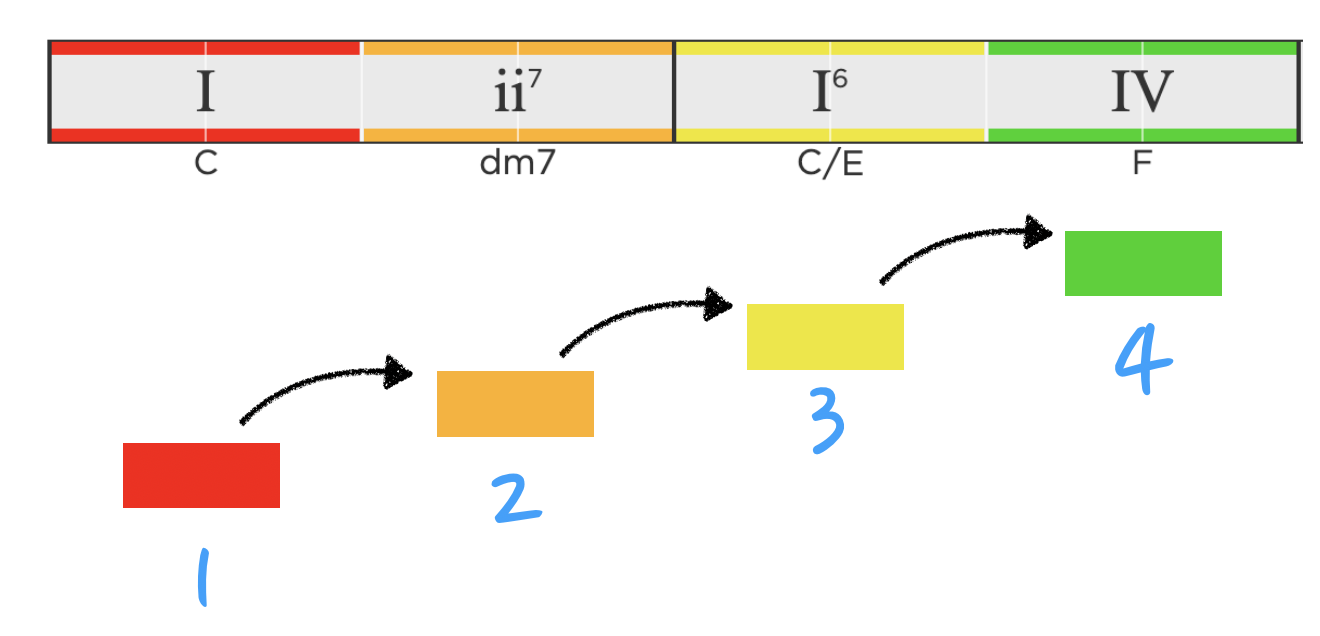
A classic example of an ascending bassline progression is I → ii7 → I6 (C → Dm7 → C/E in C major), where the bass ascends C → D → E. This rising motion can evoke brightness and uplift, as heard in Smile Smile Smile from "My Little Pony":

In Hooktheory’s relative notation, chords are colored according to their bass notes. When a progression moves stepwise through the scale, the chord colors follow a rainbow-like sequence:
Descending basslines are just as common and effective. A popular example is I → V6 → vi (C → G/B → Am), where the bass descends C → B → A. This gentle downward motion gives the progression a grounded and natural feel. Bob Marley’s No Woman, No Cry is a famous example:
Some songs combine both ascending and descending motion. The opening of Elton John’s Can You Feel the Love Tonight features a long descending bassline that transitions into a rising one, shaping the emotional arc of the introduction before the main verse begins: