Back to Music Theory Fundamentals

Chord Quality

Chord quality refers to the unique sound and emotional character of a chord, shaped by the intervals between its notes. Chords with different qualities can sound bright, dark, tense, or stable — even when built from the same root note.

The most common chord qualities in popular music are major, minor, diminished, and augmented. More advanced chords, like seventh chords, add a fourth note to introduce even more variation.

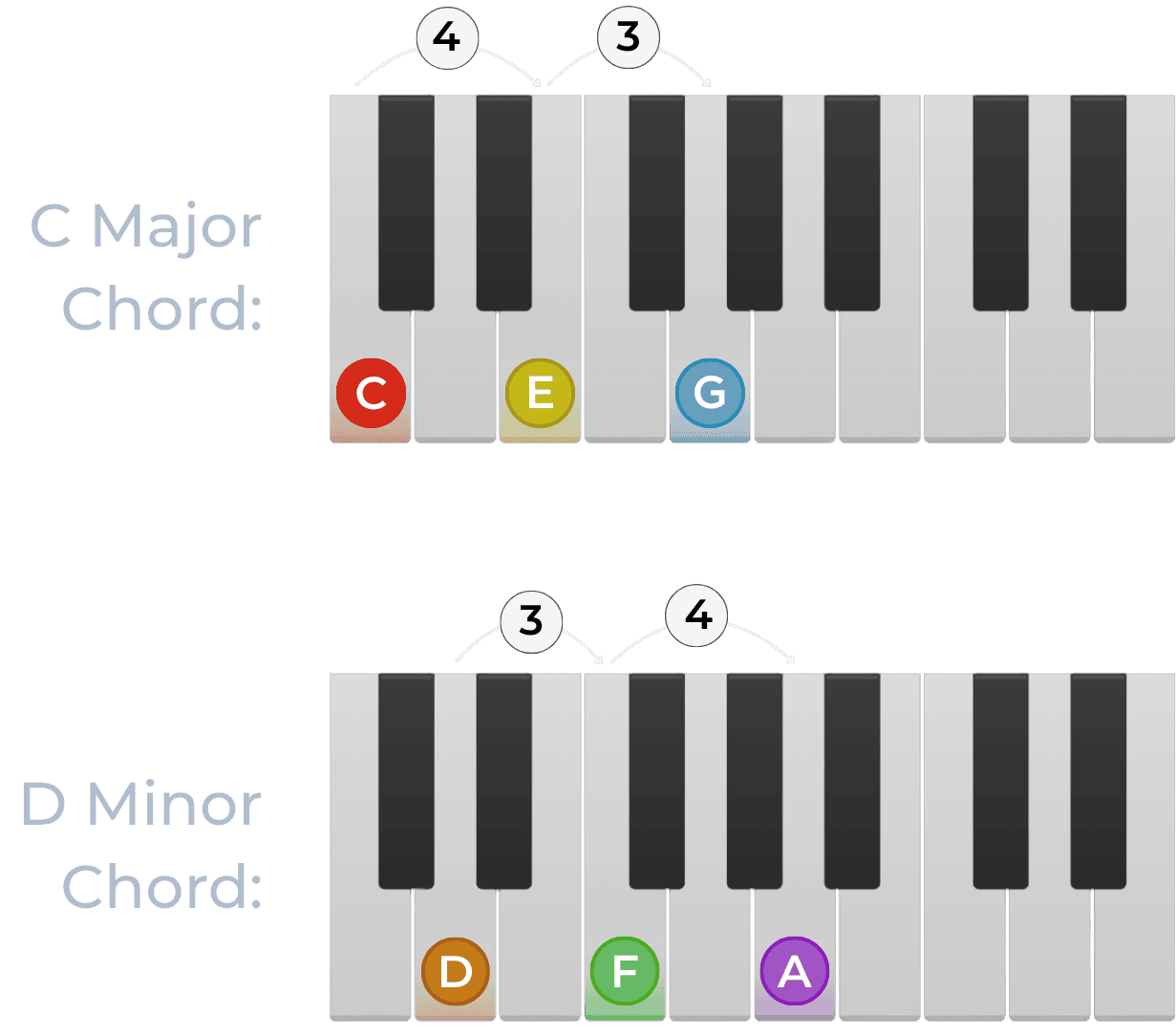
A major chord is built by stacking two intervals: a major third (4 semitones) and then a minor third (3 semitones). This structure gives major chords a bright, stable sound.

A minor chord inverts that structure — it starts with a minor third (3 semitones) followed by a major third (4 semitones), producing a more somber or introspective tone.

Below, you can compare the notes of a C major and D minor chord, showing how their interval structure affects their quality:
Chords can be extended by adding a fourth note on top — the seventh — which introduces new harmonic colors and tensions. These are called seventh chords, and their quality depends on the intervals between all four notes.

Just like triads, seventh chords come in different types depending on how the third, fifth, and seventh relate to the root. For example, a minor seventh chord contains a minor third and a minor seventh, while a dominant seventh has a major third and a minor seventh — creating a distinctive tension often used in cadences.

The table below summarizes the triad and seventh chord qualities that appear naturally in the major scale. Each row shows the chord built on a different scale degree:

Chord Quality Seventh Chord Quality
I Major I7 Major seventh
ii Minor ii7 Minor seventh
iii Minor iii7 Minor seventh
IV Major IV7 Major seventh
V Major V7 Dominant seventh
vi Minor vi7 Minor seventh
vii˚ Diminished viiø7 Half-diminished seventh

Click below to hear how a C chord can take on different qualities — including major, minor, diminished, and their seventh chord variations:

placeholder box

Other Chord Qualities: Augmented and Fully Diminished

While the chords above all come from the major scale (or related modes), other more unusual chord qualities appear in popular music — especially when altered chords are used for color or tension.

Two important altered chord types are:

  • Augmented chords, which sound unstable and bright
  • Fully diminished seventh chords, which sound tense and dramatic

Augmented Chords

An augmented chord is a major chord with a raised fifth. This gives it an expanded, unstable sound — often described as dreamy, mysterious, or tense. Augmented chords are labeled with a + symbol to reflect the altered fifth.

For example, a standard G major chord contains the notes G, B, and D. In a G augmented chord, the D is raised to D♯:
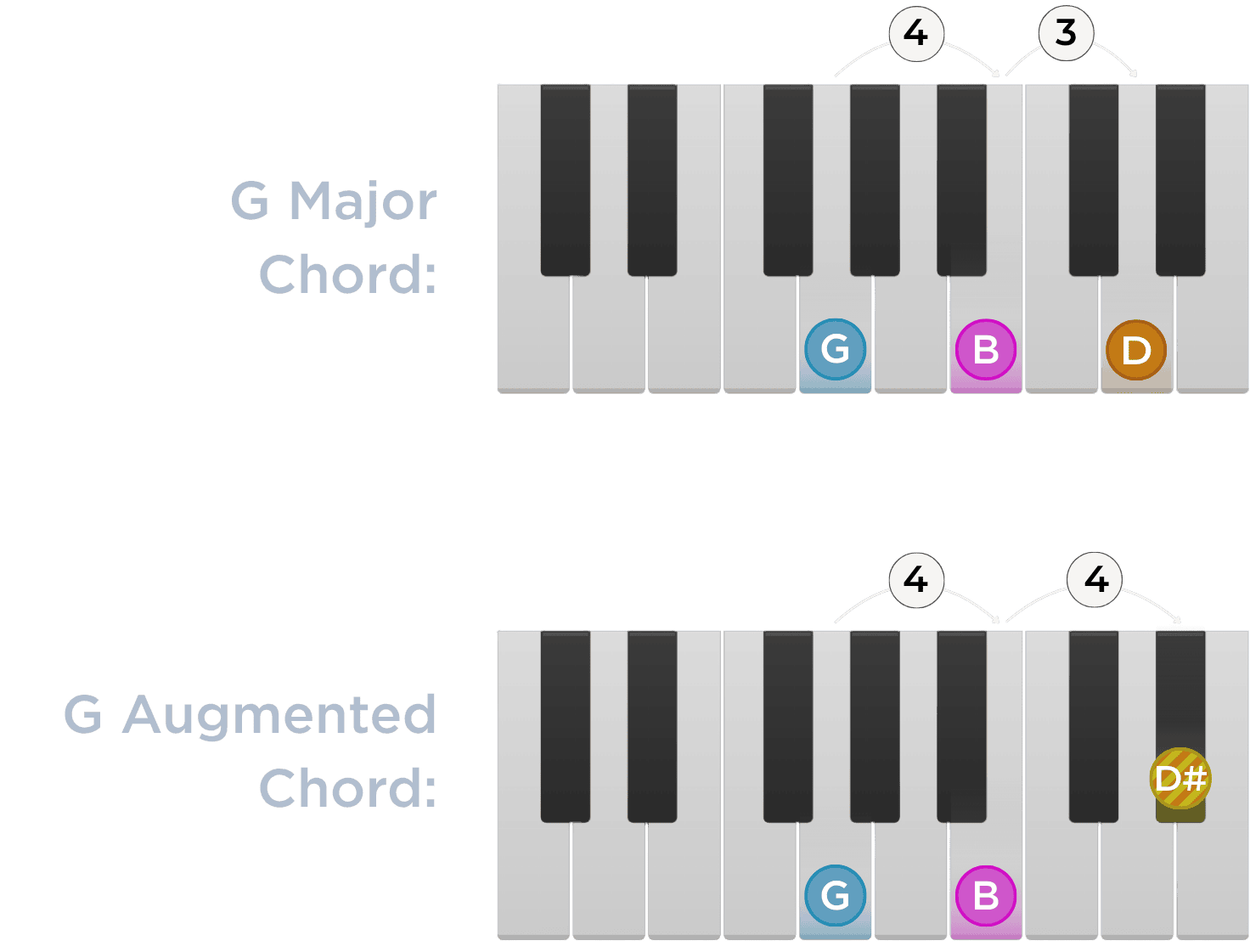
G major chord G augmented chord

Because of their symmetry and ambiguity, augmented chords aren’t always used within traditional functional harmony. Instead, they often appear in songs as “color chords” — adding drama, contrast, or a sudden shift in mood.

For example, the intro to ABBA’s Mamma Mia alternates between a regular I chord and an augmented I+ chord for a quirky and unstable sound:

placeholder box

Another common use is the V+ chord, which intensifies the pull toward the I chord. In a typical V chord, scale degree 7 resolves upward to 1. But in V+, the raised fifth (♯2) also resolves upward to 3, creating a strong and satisfying resolution.

Randy Newman’s You've Got a Friend in Me uses a V+7 chord to great effect — its jazzy flavor and strong forward motion give the progression a lot of character:

placeholder box

Other songs that use augmented chords

Click on the following songs to see their chords and melody in the TheoryTab database.

Oath to Order
by Koji Kondo
Fun Naming
by Shogo Sakai
Castlevania PoR - The Gears Go Awry
by Yuzo Koshiro
Superstition
by Stevie Wonder
Take A Bow
by Madonna
Dear Prudence
by The Beatles
Click Clock Wood
by Grant Kirkhope
The Simpsons Main Title Theme
by Danny Elfman
Delfino Plaza
by Koji Kondo
Forget You
by Cee Lo Green
Isn't She Lovely
by Jacob Collier
Kirby Triple Deluxe - Sky Cave
by Nintendo
Don't Talk - Put Your Head On My Shoulder
by The Beach Boys
Vision of Love
by Mariah Carey
Final Toccata
by Michiru Yamane
Super Robot Wars Alpha 3 - Union Is Strength
by Takuya Hanaoka
Bohemian Rhapsody
by Queen
Super Mario Galaxy - Battlerock Galaxy
by Nintendo
Mamma Mia
by ABBA
Turn Your Love Around
by George Benson
Ave Maria
by Franz Schubert
Life On Mars
by David Bowie
Bust Your Knee Caps
by Pomplamoose
Feldschlacht V
by Masashi Hamauzu
A Tiny Tiny Clever Commander
by ZUN
Mr Sandman
by The Chordettes
Sandstorm
by Jonah Wei-Haas
Castlevania SotN - Dracula's Castle
by Michiru Yamane
Oh Darling
by The Beatles
Yeul's Theme
by Masashi Hamauzu
Super Robot Wars Alpha 3 - The Garden of Baral
by Takuya Hanaoka
I'm Happy Just To Dance With You
by The Beatles
The Wall Street Shuffle
by 10cc
I'm So Tired
by The Beatles
What a Wonderful World
by Louis Armstrong
Beloved Tomboyish Girl
by ZUN
SDF Macross - Dog Fighter
by Kentarou Haneda
I Am the Walrus
by The Beatles
Where Your Eyes Don't Go
by They Might Be Giants
Space Dementia
by Muse
Sinking Feeling
by Jack Conte
Scheisse
by Lady Gaga
Gimmick - Happy Birthday
by Masashi Kageyama
Komm Susser Todd
by Shiro Sagisu
Buttons
by The Pussycat Dolls
Lovefool
by The Cardigans
Pokemon Red Blue Opening
by Nintendo
Lon Lon Ranch
by Nintendo
A Day In The Life
by The Beatles
Mega Man and Bass - Tengu Man Stage
by Capcom
Super Mario Bros 2 - Overworld Theme
by Koji Kondo
Only 1
by Ariana Grande
The Continuing Story of Bungalow Bill
by The Beatles
Fixing A Hole
by The Beatles
Have yourself a merry little Christmas
by Michael Buble
Humoresque Op 101 No 7
by Antonin Dvorak
Smoke Gets In Your Eyes
by Jerome Kern
Route 113
by Game Freak
Stairway to Heaven
by Led Zeppelin
Littleroot Town - Pokemon Ruby and Sapphire
by Nintendo
The Wings of a Boy Who Killed Adolescence
by Kow Otani
Don't Know Why
by Norah Jones
F-Zero - Mute City
by Yumiko Kanki
Mario Brothers Water Theme
by Koji Kondo
Non Je ne regrette rien
by Edith Piaf
Route 225 - Night
by Game Freak
Sing It Back
by Moloko
Uninvited
by Alanis Morissette
Bamboo Forest of the Full Moon
by ZUN
In The Hall Of The Mountain King
by Edvard Grieg
If I Could
by 1927
Dance of the Sugar Plum Fairy
by Pyotr Ilyich Tchaikovsky
KK Bossa
by Kazumi Totaka
Castlevania HoD - Successor of Fate
by Soshiro Hokkai
Doll's Story - Doll of Misery
by ZUN
New
by Paul McCartney
The Freaking FCC
by Walter Murphy
Into The Great Wide Open
by Tom Petty
We Intertwined
by The Hush Sound
Bad Day
by Daniel Powter
Love You Like A Love Song
by Selena Gomez
Animals
by Muse
**** You
by Lily Allen

Fully Diminished Seventh Chords

The vii˚ chord in a major key is a diminished triad built from scale degrees 7, 2, and 4. When extended into a seventh chord, it usually becomes a viiø7 — a half-diminished seventh chord.

The half-diminished seventh includes a diminished triad plus a minor seventh above the root. In the key of C, that gives us the notes B, D, F, and A:

Half-diminished chord: Bø7

Half-diminished B7 chord

This chord is tense and unstable, but not as intense as the fully diminished seventh chord. In a fully diminished chord, all the notes are spaced by minor thirds, including the seventh — which becomes a diminished seventh interval (9 semitones instead of 10).

Fully diminished chord: Bo7

Fully diminished G#7 chord

This tight interval spacing gives the chord a more intense and dramatic sound. It often shows up in minor keys when composers use the harmonic minor scale — which raises scale degree 7 to strengthen resolution to the tonic.

For example, in A minor, raising G to G♯ turns the viiø7 chord into a fully diminished viio7 chord (G♯, B, D, F). You can hear this effect in ABBA’s The Day Before You Came, which opens with a dramatic viio7 chord:

placeholder box

Fully diminished seventh chords also appear as applied chords — acting as temporary leading chords to other targets. While not as common as V or IV of a chord, applied vii˚7 chords still show up frequently and are especially popular in jazz and musical theater.

Both You've Got a Friend in Me and The Day Before You Came use these types of applied viio7 chords to create momentary tension before resolving elsewhere — like viio7/V, viio7/♯vi, or viio7/VI.

Songs that use fully diminished seventh chords

Click on the following songs to see their chords and melody in the TheoryTab database.

Gentle Annie
by Stephen C Foster
Badinerie
by Johann Sebastian Bach
Komm Susser Todd
by Shiro Sagisu
Man In The Mirror
by Michael Jackson
Meet the New Mozart
by Prefab Sprout
Piano Sonata No 14 ''Moonlight'' 3rd Movement
by Ludwig Van Beethoven
God Only Knows
by The Beach Boys
Castlevania Dawn of Sorrow - Into the Dark Night
by Masahiko Kimura
Super Mario Galaxy 2 - Sky Station Galaxy
by Nintendo
Wasted Time
by Skid Row
Neva
by Symbolyc One feat Tone Trezure
BWV 227 Jesu Meine Freude - 1st Movement
by Johann Sebastian Bach
Michelle
by The Beatles
Nocturne in Eb
by Frederic Chopin
Castlevania PoR - Gaze Up at the Darkness
by Michiru Yamane
Lifestyle
by Rich Gang
Actraiser - Fillmore
by Yuzo Koshiro
Space Dementia
by Muse
Baby I'm Yours
by Breakbot feat Irfane
Ave Maria
by Franz Schubert
Butterflies and Hurricanes
by Muse
Prelude no 1 in C major BWV 846
by Johann Sebastian Bach
Ame ga Furu
by Maaya Sakamoto
Tristan und Isolde - Prelude
by Richard Wagner
Thousands of Barack Obamas
by schmoyoho
Carol Of The Bells
by John Williams
My Cheri Amour
by Stevie Wonder
Diddy Kong Racing - Wizpig Race
by Nintendo
Lovefool
by The Cardigans
Opelucid City - White Version
by Game Freak
I Believe I Can Fly
by R Kelly
Dance of the Sugar Plum Fairy
by Pyotr Ilyich Tchaikovsky
Massachusetts
by Ylvis
Piano Sonata No 8 ''Pathetique'' - 3rd Movement
by Ludwig Van Beethoven
Super Smash Bros Brawl Opening
by Nintendo
Space Battleship Yamato - White Comet Disco
by Hiroshi Miyagawa
The Simpsons Main Title Theme
by Danny Elfman
Route 209
by Game Freak
Dark World Theme - The Legend of Zelda ALttP
by Koji Kondo
Have yourself a merry little Christmas
by Michael Buble
For the First Time in Forever
by Kristen Bell and Idina Menzel
Nara
by Es Posthumus
Smoke Gets In Your Eyes
by Jerome Kern
Where Everybody Knows Your Name - Cheers Theme
by Gary Portnoy
Yeul's Theme
by Masashi Hamauzu
Super Robot Wars Alpha 3 - The Abyss
by Takuya Hanaoka
Kirby Triple Deluxe - Sky Cave
by Nintendo
Mad Monster Mansion
by Grant Kirkhope
Mario and Luigi Bowser's Inside Story - The Giant
by Yoko Shimomura
Sophisticated Lady
by Duke Ellington
Combat Mecha Xabungle - Blue Flash
by Koji Makaino
MOTHER 3 Going Alone
by Shogo Sakai
Binks No Sake
by Kohei Tanaka
Helena
by My Chemical Romance
Click Clock Wood
by Grant Kirkhope
Crucifix Held Close
by Michiru Yamane
A Tiny Tiny Clever Commander
by ZUN
Super Robot Wars Alpha 3 - Union Is Strength
by Takuya Hanaoka
Super Mario World - Fortress
by Koji Kondo
Lake
by Game Freak
Attack of the Giga Zombie - Underworld Map
by Takashi Kutsukake
Bohemian Rhapsody
by Queen
Liebestod - Isoldes Verklaerung
by Richard Wagner
Orange Twilight So Close
by Funczion Sounds
SDF Macross - Dog Fighter
by Kentarou Haneda
Piano Sonata No 14 ''Moonlight'' 1st Movement
by Ludwig Van Beethoven
Letter From You My Sweet
by Shogo Sakai
Bust Your Knee Caps
by Pomplamoose
Human of the Year
by Regina Spektor
Symphony no 40 in G minor - I
by Wolfgang Amadeus Mozart
L-O-V-E
by Nat King Cole
Symphony no 5 in C minor - I
by Ludwig Van Beethoven
Libertango
by Astor Piazzolla
New Super Mario Bros Wii - Castle
by Nintendo
Yuusha Raideen
by Masato Shimon
Symphony No 4 in E minor - I Allegro non troppo
by Johannes Brahms
Bolero of Fire
by Nintendo
Family Guy - Theme Song
by Walter Murphy
This Love
by Maroon 5
We Are the Champions
by Queen
Intro Jingle
by College Humor
Flaming Moe's
by Jeff Martin
All The Things You Are
by Jerome Kern
Eterna Forest
by Game Freak
Kirby's Epic Yarn - Patch Castle
by Nintendo
Breathe (In The Air)
by Pink Floyd
BWV 894 - Prelude in A minor
by Johann Sebastian Bach

Contents

Music Fundamentals

The 7 notes that are the building blocks of a song
The spacing between notes

Functional Harmony

The study of how chords work
Establishing the set of notes and chords used in a song
A powerful framework for understanding how songs work
Numbering notes within a key
Numbering chords within a key

Basic Chord Concepts

Chords naturally found in the key
Different chord sounds and their function
Different ways of playing or arranging the same chord
Ending a musical idea

Melody

A song's rhythmic framework
Understanding melody tension over chords

Advanced Chords

Using a different bass note to change a chord's sound
Adding one more note to the basic chords
Chords that temporarily shift the harmonic center
A chord with built in tension and release
A chord with an added tone that enriches its sound
Using chords from parallel modes for contrast and emotion
Jazz harmonic technique replacing dominant chords with chords a tritone away
Altered (raised or lowered) notes create tension and complexity in chords

Advanced Concepts in Harmony

Two ways to change a song's key
Borrowing chords from another key
New scales and home base chords for a different mood
Using notes within and outside a song's key
Progressions that connect the bass