Relative Notation
Relative notation assigns numbers to notes based on their position within a scale, rather than their letter names. This approach emphasizes a note's musical function, allowing us to understand and compare melodies and chords across different keys.
In relative notation, notes are referred to as scale degrees. By utilizing the numbers 1 through 7, this system highlights the consistent roles and relationships between notes, which is useful for understanding songs across different keys. For example, the note C in a C major scale becomes scale degree 1, while in a G major scale, the same scale degree 1 would be G. In Hooktheory’s visual representation, scale degrees are assigned a unique color (red for 1, orange for 2, etc.) to visually reinforce the function of the note and to make it easier to identify the scale degree at a glance.
To summarize: A song is written in a key defined by a scale (e.g., C major):
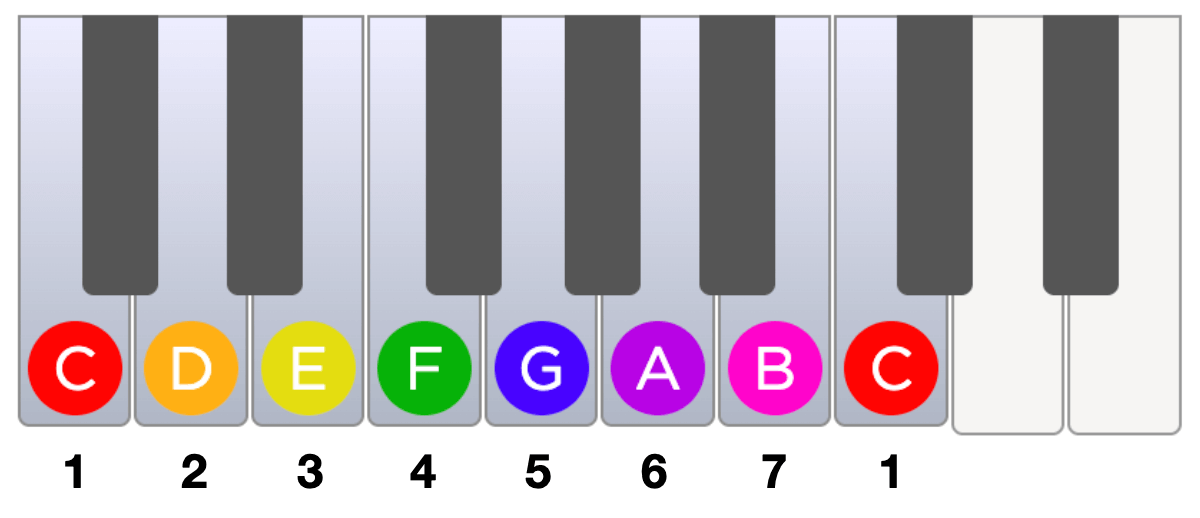
The notes of the scale are mapped to colored and numbered scale degrees. Groups of these scale degrees played together are used to form chords, which are also numbered (using Roman numerals) based on the root scale degree:
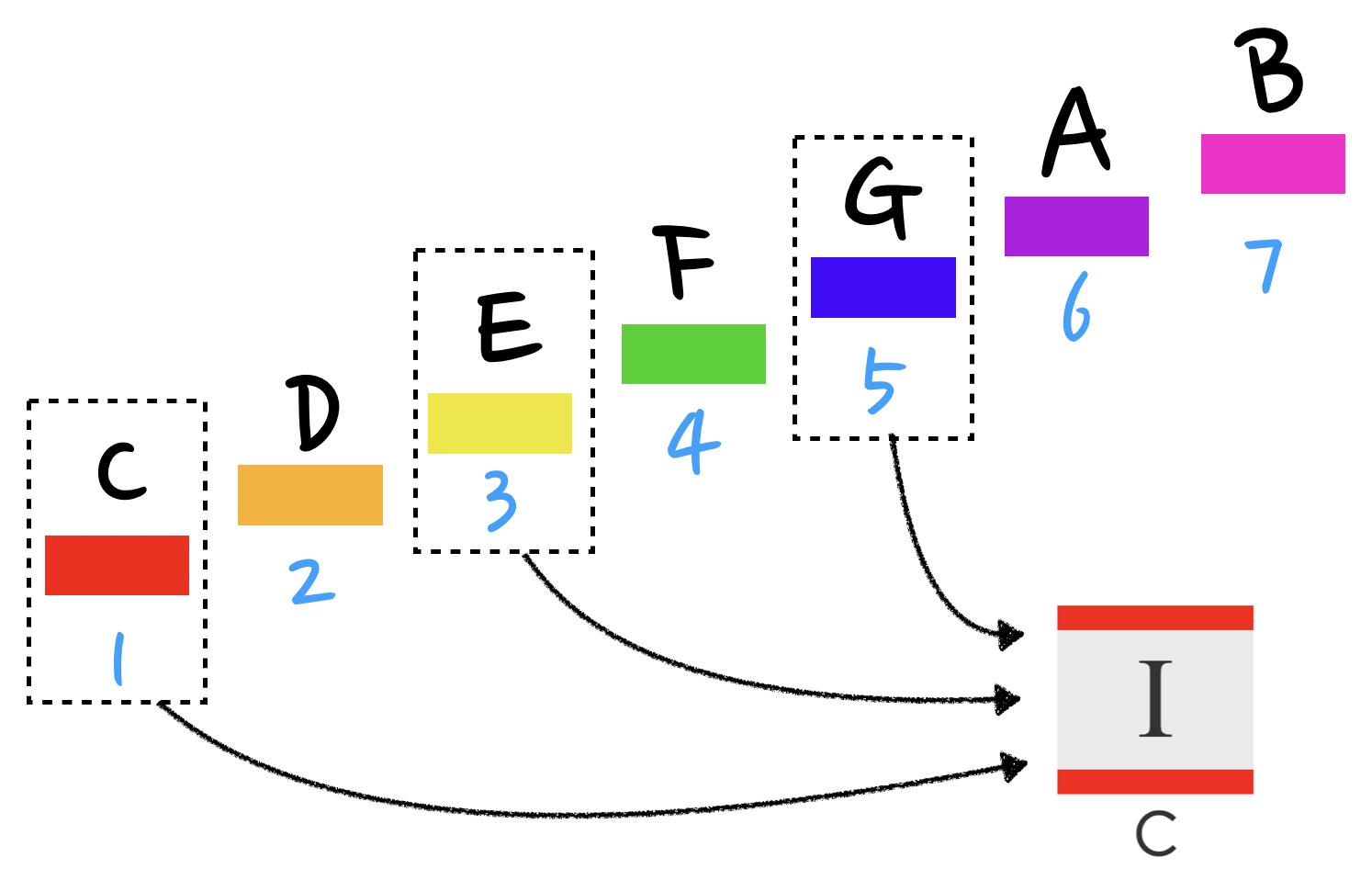
These colored scale degrees and chords are placed on a relative staff, showing the notes and chords in a song over time. Because the key of the song is abstracted away, it allows direct comparison of chord and melody function between songs in different keys.

For more information about the relative notation system used in Hookpad, check out the free introductory chapter to Hooktheory: Music Theory for Songwriting.