Scale
Scales are collections of notes that provide the foundation for melodies and chords in music. The most familiar is the major scale — a series of seven notes that follow a specific pattern of intervals (steps between notes). This pattern gives the major scale its bright, familiar sound and is used in countless popular songs.
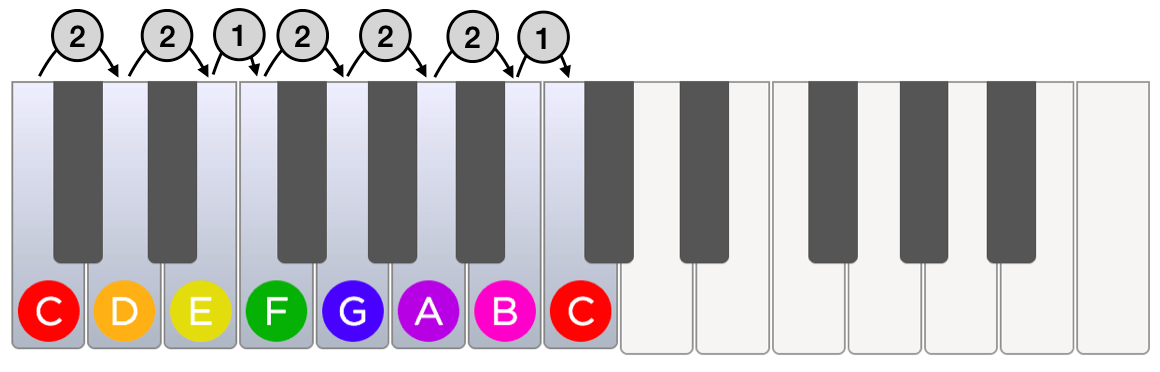
Below is the C major scale, labeled with the number of half steps between each note. These intervals define the structure of the scale. On the piano, playing just the white keys produces this scale, with most notes separated by 2 half steps (a whole step) and a few separated by just 1 half step.
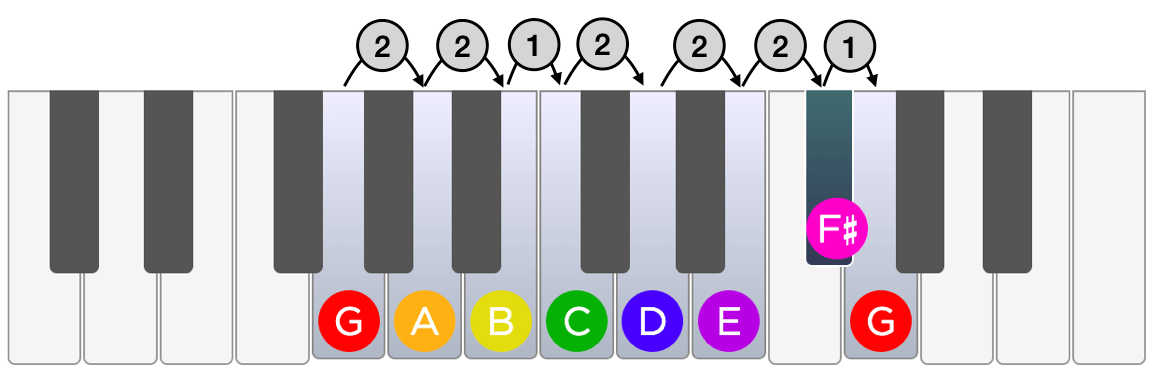
Here is the G major scale. It uses the same pattern of intervals as the C major scale, but starts on a different note. To preserve the same sound (i.e., the same spacing between notes), it includes one black key (F♯).
Each note in a scale is assigned a scale degree, numbered 1 through 7. These scale degrees stay the same across different keys, allowing us to describe musical ideas using relative notation — a core concept in Hooktheory. For example, scale degree 1 is always the "home" note of the key, even though its actual pitch changes from one key to another.
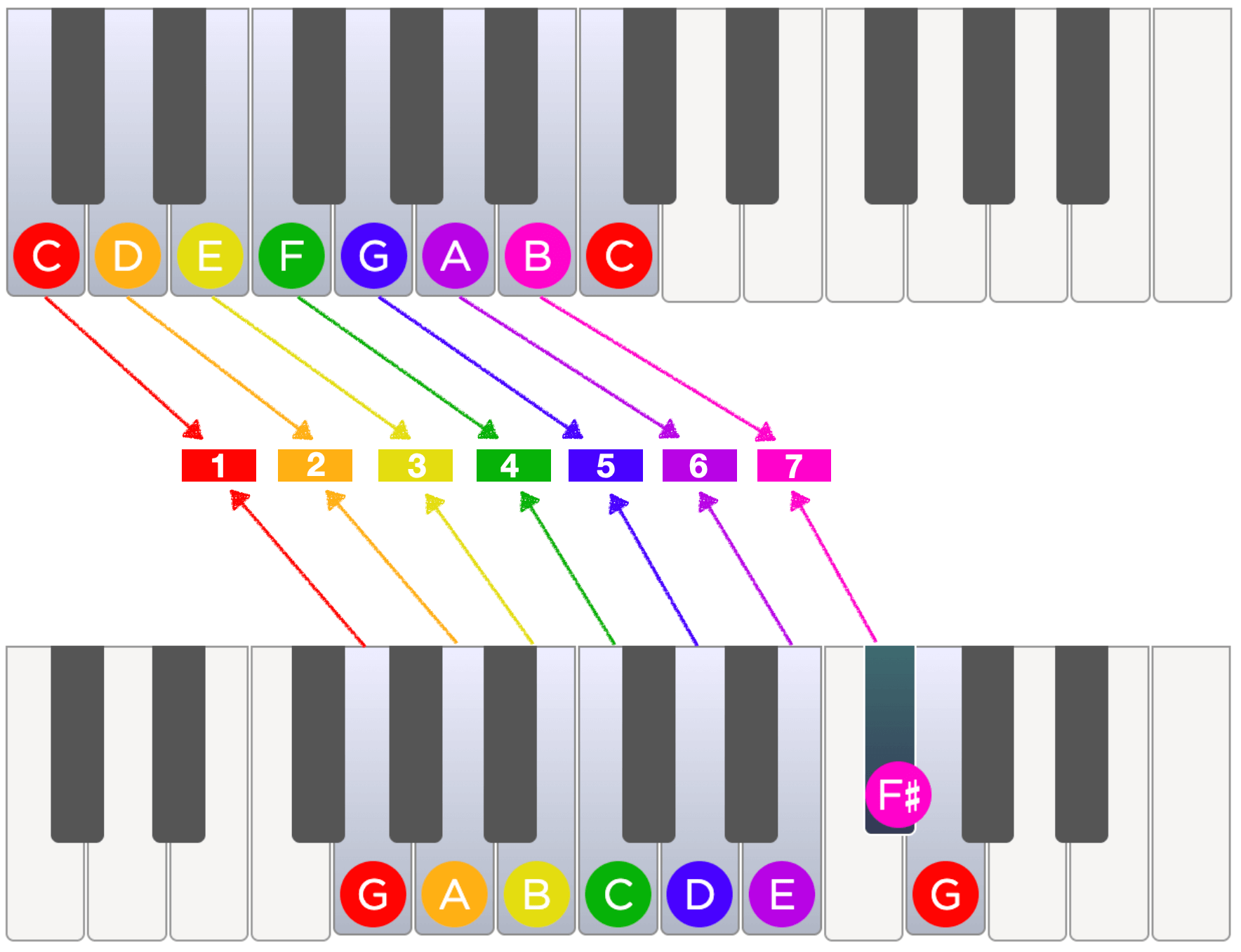
At Hooktheory, we color each scale degree of the major scale consistently — red for 1, orange for 2, yellow for 3, and so on — so you can recognize their role and function instantly, no matter what key you're in. Try out the interactive graphic below to hear how the same pattern sounds in different keys!
