Back to Music Theory Fundamentals

Scale Degree

Scale degrees refer to the position of a note within a scale, numbered 1 through 7. These numbers reflect the note’s distance from the tonic — the first note of the scale — and describe how each note functions in the key.

For example, in the C major scale, D is scale degree 2, while in G major, D is scale degree 5. Even though it's the same note, its role in the key changes.

Scale degrees are used to denote the position of a particular note within a scale, referred to by the numbers 1 through 7 (or alternatively using Solfege, e.g., Do, Re, Mi). In Hooktheory, we use relative notation — based on scale degrees — to make it easy to understand and compare music regardless of the key it’s in. This makes it easy to transpose songs, spot common chord progressions, and identify patterns across different keys.
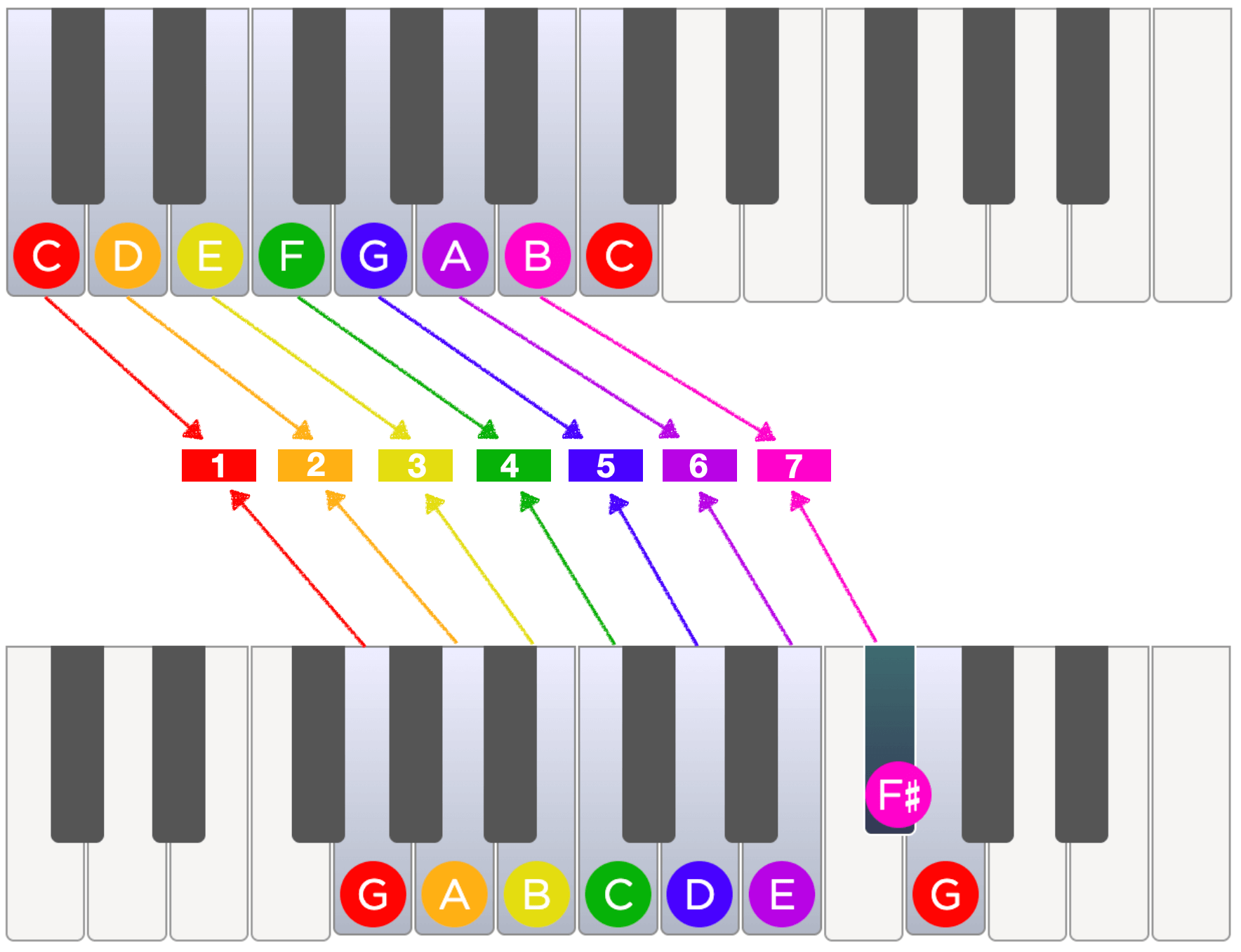
Scale degree comparison in C and G major

In the example above, you can see how the same note (D) maps to different scale degrees in C major and G major. Hookpad uses this relative system to help you focus on how notes and chords function in context — not just their letter names.

Contents

Music Fundamentals

The 7 notes that are the building blocks of a song
The spacing between notes

Functional Harmony

The study of how chords work
Establishing the set of notes and chords used in a song
A powerful framework for understanding how songs work
Numbering notes within a key
Numbering chords within a key

Basic Chord Concepts

Chords naturally found in the key
Different chord sounds and their function
Different ways of playing or arranging the same chord
Ending a musical idea

Melody

A song's rhythmic framework
Understanding melody tension over chords

Advanced Chords

Using a different bass note to change a chord's sound
Adding one more note to the basic chords
Chords that temporarily shift the harmonic center
A chord with built in tension and release
A chord with an added tone that enriches its sound
Using chords from parallel modes for contrast and emotion
Jazz harmonic technique replacing dominant chords with chords a tritone away
Altered (raised or lowered) notes create tension and complexity in chords

Advanced Concepts in Harmony

Two ways to change a song's key
Borrowing chords from another key
New scales and home base chords for a different mood
Using notes within and outside a song's key
Progressions that connect the bass