Scale Degree
Scale degrees refer to the position of a note within a scale, numbered 1 through 7. These numbers reflect the note’s distance from the tonic — the first note of the scale — and describe how each note functions in the key.
For example, in the C major scale, D is scale degree 2, while in G major, D is scale degree 5. Even though it's the same note, its role in the key changes.
Scale degrees are used to denote the position of a particular note within a scale, referred to by the numbers 1 through 7 (or alternatively using Solfege, e.g., Do, Re, Mi). In Hooktheory, we use relative notation — based on scale degrees — to make it easy to understand and compare music regardless of the key it’s in. This makes it easy to transpose songs, spot common chord progressions, and identify patterns across different keys.
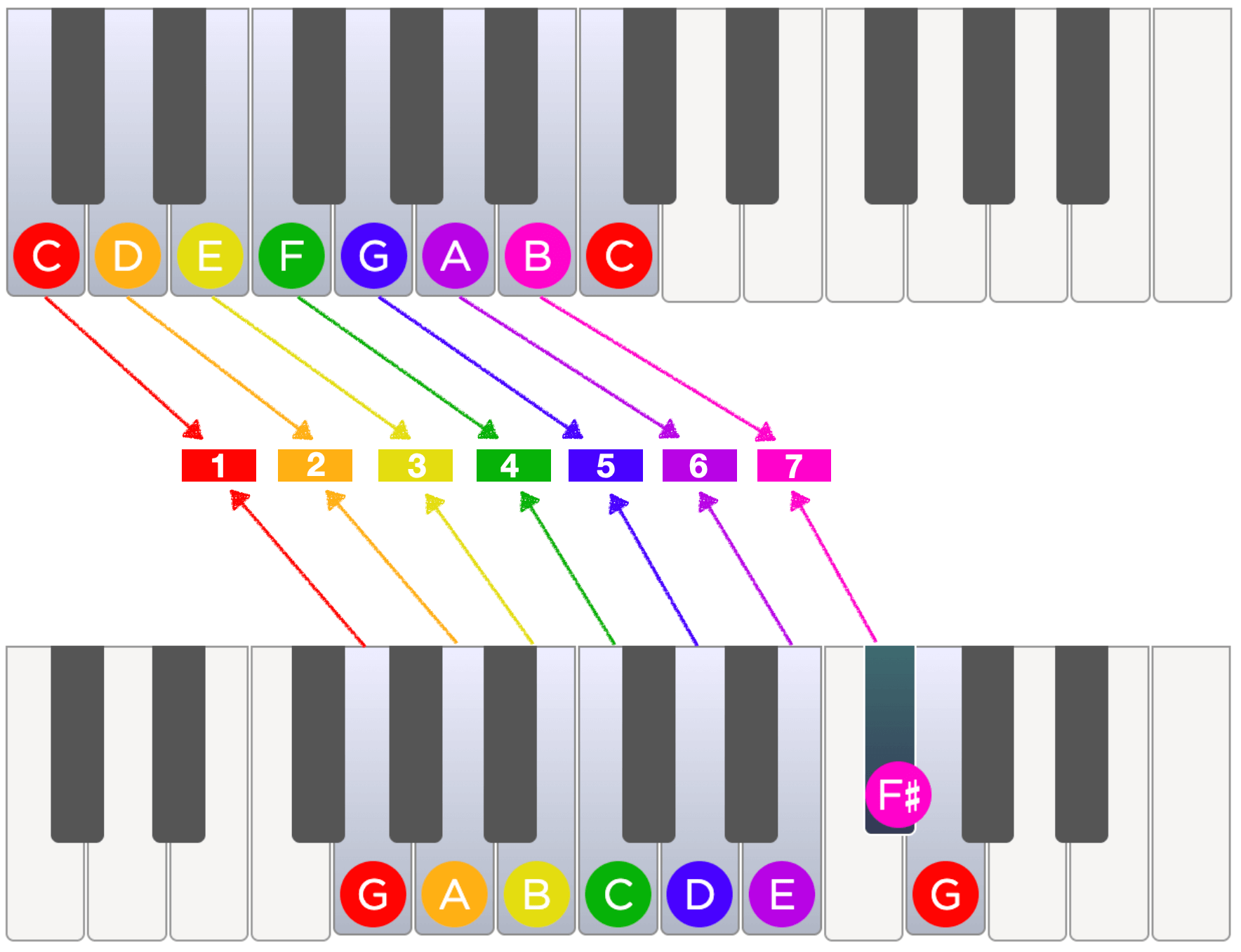
In the example above, you can see how the same note (D) maps to different scale degrees in C major and G major. Hookpad uses this relative system to help you focus on how notes and chords function in context — not just their letter names.